HUMAN API


Between sets
This started on my living room floor. I was doing chest presses in the space between my living room and kitchen, in the middle of a session with my trainer.
Between sets, we talked about the business I'm launching, and then about her. She was excited, describing everything she had going on and everything she wanted to build. Then her voice changed. With a few things happening in her life, she said, she just didn't feel like she had the bandwidth.
I told her I had a word for that: capacity.
Something clicked for both of us. Building something new, doing work I'm proud of, being present for the people I love: each asks something of me. The hours might be available while the attention, patience or energy isn't.
Capacity is energy. That's how I experience it. It's the room inside a life to meet what matters with something left to give.
And that gives me a different way to think about AI.
Everything, except room
I know the feeling of having all the tools, all the ideas and enough resources to begin, yet no room for execution. The plan is there. The work still doesn't happen. Buying another tool can feel like movement, especially when the more difficult question is what I can actually carry.
Sometimes life isn't ready. The timing, support or circumstances don't yet allow the move. Sometimes we aren't ready. There may be something to learn, a decision to make or a commitment we haven't honestly chosen. A good idea can deserve a later season.
Readiness is worth examining. What would it require? Support, recovery, a clearer first step, a smaller commitment? Or is this something I like imagining more than I want to do? An honest answer gives us something useful to work with.
A shared intention
People approach energy work in different ways. Some think of spiritual practices, intuition or the unseen. I'm open to that world. I work with a psychic, and I take it seriously. I meditate afterward. That space to reflect is part of what I value: time to notice what I'm thinking and feeling, and to consider another perspective. The connection I see is a shared intention: become more aware of what we are carrying, gain perspective and direct our energy with greater purpose. Across different approaches, I recognize that ambition for expanded capacity.
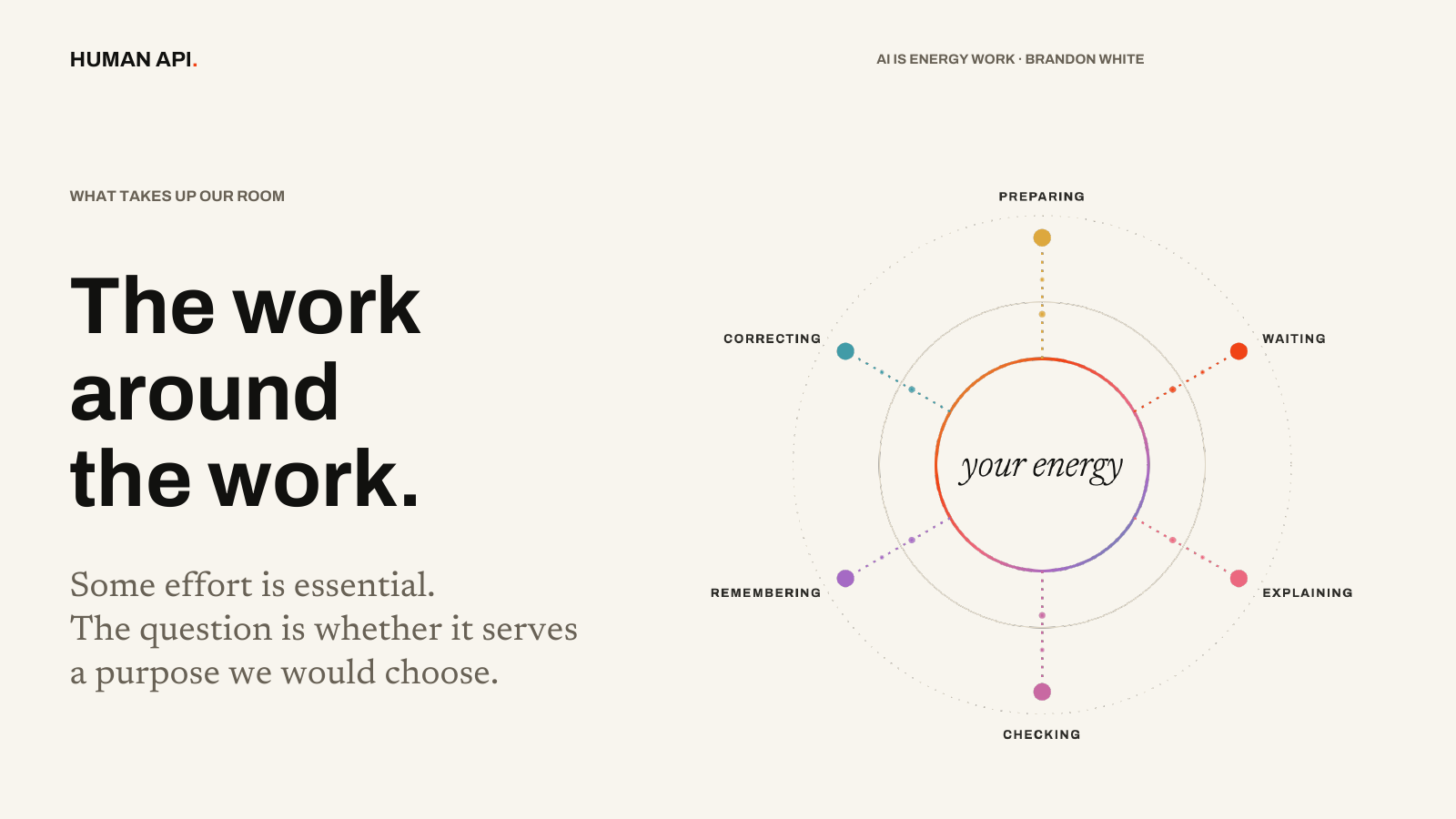
That intention matters in a business, too. A leader can feel stretched while the calendar looks reasonable. A team can produce more while its people have less room to think. The cost often sits between the visible tasks: gathering context, chasing an answer, re-explaining a decision, checking a draft, repairing a handoff.
Some of this effort is essential. Preparation can be an act of care. Reviewing a consequential decision is part of doing the job. Learning something worthwhile takes energy before it gives anything back. The distinction is whether the effort serves a purpose we would choose, and whether its full cost is understood.
Capacity has several dimensions. We need usable time, attention, physical energy, emotional room, resources and reliable support. These influence each other without being interchangeable. An empty afternoon may offer little relief if a difficult conversation occupies it. A larger team may create little room if every decision still returns to one person.
Capacity for what?
So I keep coming back to a question: capacity for what?
For a founder, it may be time to think about the next stage of the business. For an agent, it may be arriving at a client conversation prepared enough to listen. For me, it includes building something that lasts, training, curiosity, giving back and being available to the people I love. More room needs somewhere meaningful to go, or the next request can claim it.
Where AI comes in
AI belongs in this conversation because it can help with some of the effort that consumes that room. It can assemble information, organize a first draft or make an unresolved question easier to see. Its usefulness depends on the information available, the instructions given and the care taken with the result. It can also add work: checking invented details, maintaining another system or explaining an output nobody trusts.
Consider a client meeting. A team member has notes to organize, commitments to check and open questions to prepare. Using information approved for the tool, AI could help assemble a briefing and identify missing details. The team member checks it against the source, removes assumptions and identifies what requires a decision. The leader arrives prepared to listen. The relationship, commitments and decisions remain people's responsibility.
The test includes the whole arrangement. How much preparation does the tool need? What takes checking or correction? Does someone now spend longer cleaning up the output? Can the leader rely on it without mentally doing the work twice? A faster draft alone tells us very little. The useful result is a person with more room to give the meeting their attention, with preparation and review together more manageable and quality intact.
Room makes room
Intuition has a place here. Sometimes I feel the weight of a responsibility before I can explain why. That feeling is worth listening to. It is a starting point for inquiry: what am I noticing, what am I assuming, and what would help me tell the difference?
Perspective lets me widen the view. Perhaps the task is reasonable but the timing is wrong. Perhaps someone else needs clearer authority. Perhaps the familiar way of doing it has become expensive. A colleague may see something I miss. A record of what actually happens may challenge my first impression.
More room can make this reflection easier. A thoughtful change may create enough breathing space to notice the next one. That is the loop I care about: room to notice, a clearer choice, support that works, more room. It takes attention and adjustment.
See. Sort. Choose.
At Human API, the three stages of my P.R.A.C.T.I.C.A.L. method are See, Sort and Choose. They give this idea a practical place to begin.
See one situation as it actually works. Follow the responsibility from the first signal through completion. Include who remembers, prepares, decides, waits, checks and repairs. Ask the other people involved what it costs them. The visible task is only part of the picture.
Sort what each part needs. Some work belongs with your judgment or presence. Some needs a clearer agreement, a capable person with authority, or a reliable routine. Some may suit bounded AI assistance. Some can stop. Give the work a home that includes the context and responsibility needed to carry it.
Choose one change to test. Agree who owns it, where a person must review it and when you will look again. Decide what would count as improvement, including the effort of setting it up and keeping it useful. Then notice whether it creates room for the purpose you named. Adjust what needs adjusting.
There is no requirement to reorganize your whole life before beginning. Equally, a small process change cannot resolve every demand a life contains. Sometimes the useful choice is asking for help, postponing something or accepting a limit. Capacity work includes those decisions.
What the room is for

I'm launching something new, so this is close to home. I can feel the pull to use every available hour. What I'm practicing is paying attention to what that choice asks of the rest of my life, and arranging the work with more care.
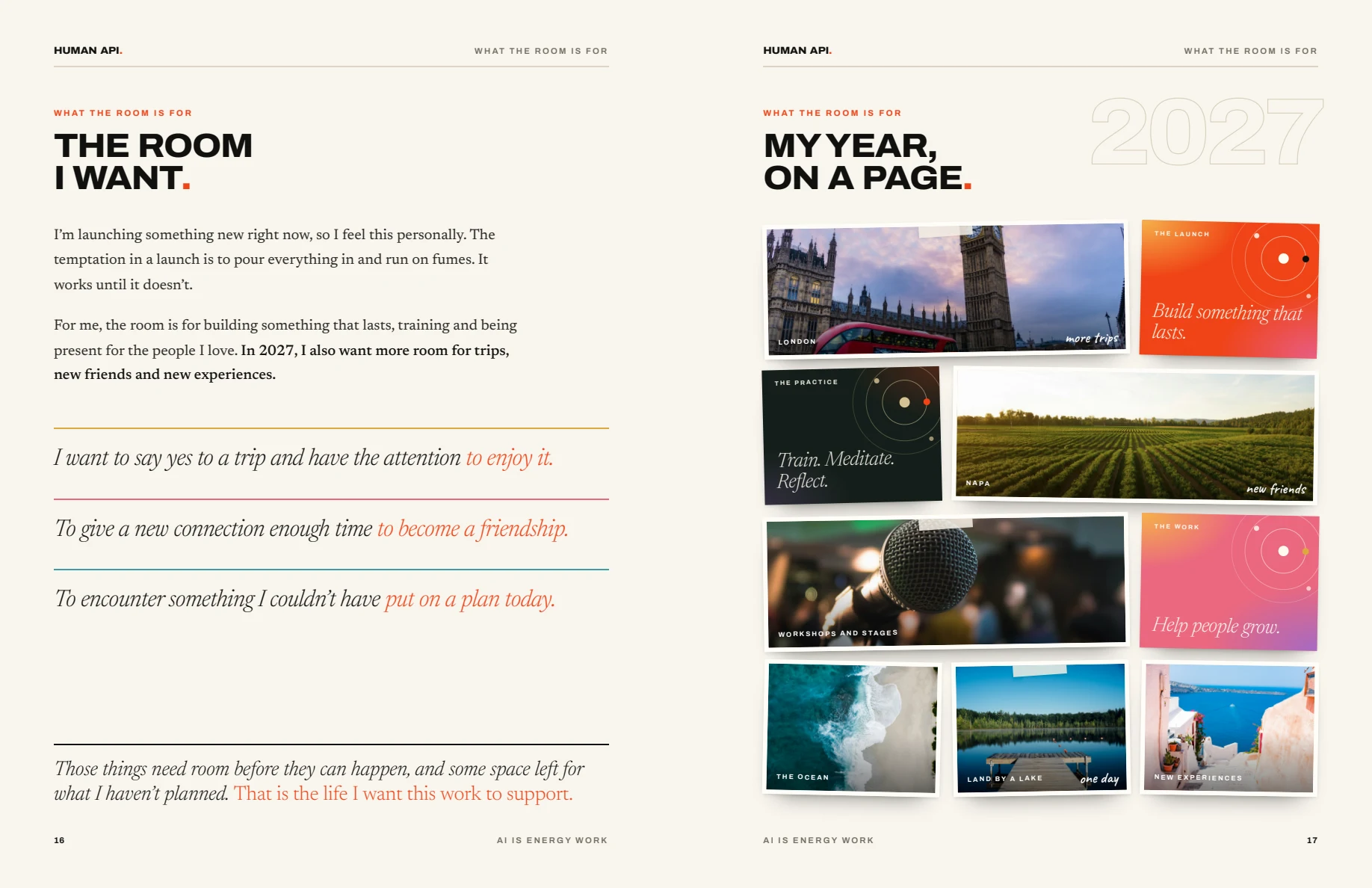
In 2027, I want more capacity for trips, new friends and new experiences. I want to say yes to a trip and have the attention to enjoy it. To give a new connection enough time to become a friendship. To encounter something I couldn't have put on a plan today.
Those things need room before they can happen. I want the practical arrangements around my life to let me follow through on those intentions, with some space left for what I haven't planned. That means asking what I need to resolve, share, stop or support now, so the possibility can become part of an actual life.
There is something I like about that connection: I make room to reflect, and I want more life to reflect on. A wider perspective can help me choose what comes next. Making room for a new experience gives me something else to consider.
The conversation between sets stayed with me because it gave language to something familiar. We can want more and need room at the same time. We can be capable people with full lives. We can choose support without surrendering the judgment, care or ambition that makes the work ours.
If you had more room tomorrow, what would you make room for?
Start there. That is what the energy is for.
— B